Choosing your custom wedding bands: metals, profiles, lead times
The wedding band is the only piece of jewelry worn every day for decades. This should guide the choice, and is most often forgotten in favor of aesthetics of the moment.
When to start the project
Four to six months before the date. Not because manufacturing requires it – a pair of wedding bands can be made in four to six weeks – but because this timeframe allows for trying on several profiles, changing your mind, and adjusting after an initial fitting.
Choosing the metal based on use
White gold and rhodium plating
White gold is not white. It is an alloyed gold, whose shade naturally tends towards warm gray, and which is covered with a thin layer of rhodium to obtain the brilliant white associated with it.
This layer wears off. Depending on skin type, products, and intensity of wear, rhodium plating needs to be redone every two to three years, sometimes less for a very active hand. It's a simple and inexpensive operation, but it exists, and few sellers mention it at the time of purchase.
If the idea of recurring maintenance bothers you, two options: accept the natural shade of unrhodium-plated white gold, which has its own character, or choose platinum.
Platinum
Naturally white, without rhodium plating. Denser, therefore heavier on the finger, which some like and others don't. It doesn't wear by losing material but by displacing it, and develops a matte patina over the years that can be kept or restored as desired. More expensive to buy, with no recurring maintenance.
Yellow gold and rose gold
No surface treatment, therefore no scheduled redoing. Their color is that of the alloy itself and will not change. They show scratches like all gold, but occasional polishing is sufficient.
Matching the wedding band to the engagement ring
The contour
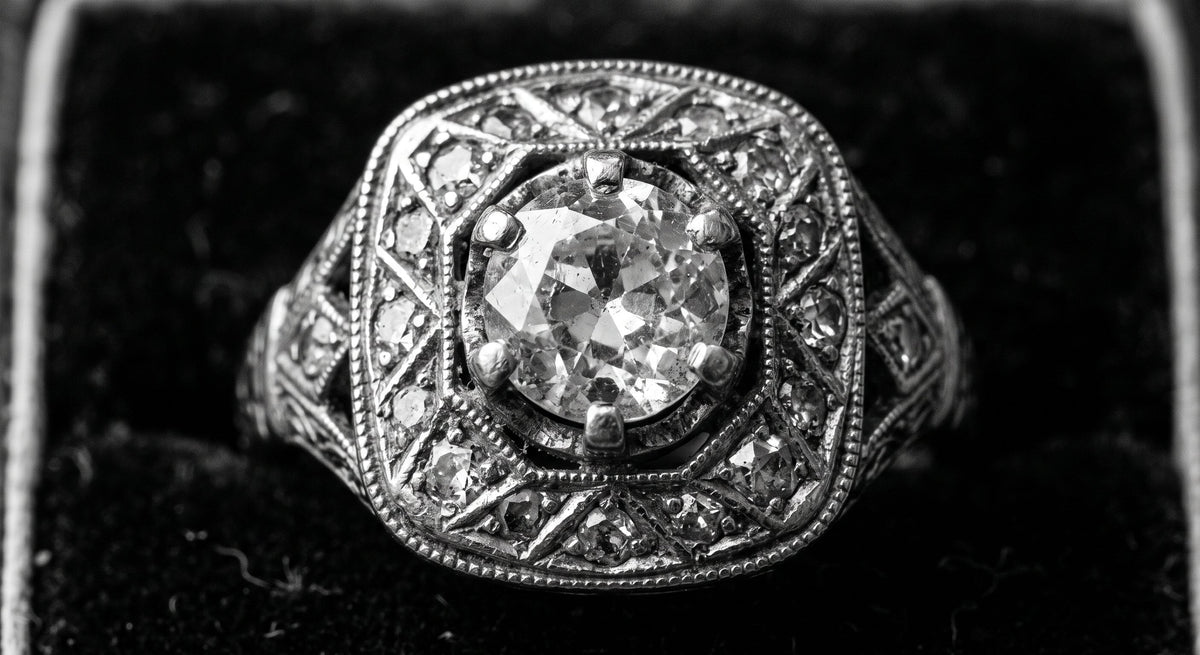
A straight wedding band placed against an engagement ring with a protruding stone often leaves an unsightly gap. The contour, designed to fit the setting of the first ring, solves the problem and can be custom-made from the existing ring.
Bring it to the first appointment: the design is made from it, not from a photograph.
Wear between two rings
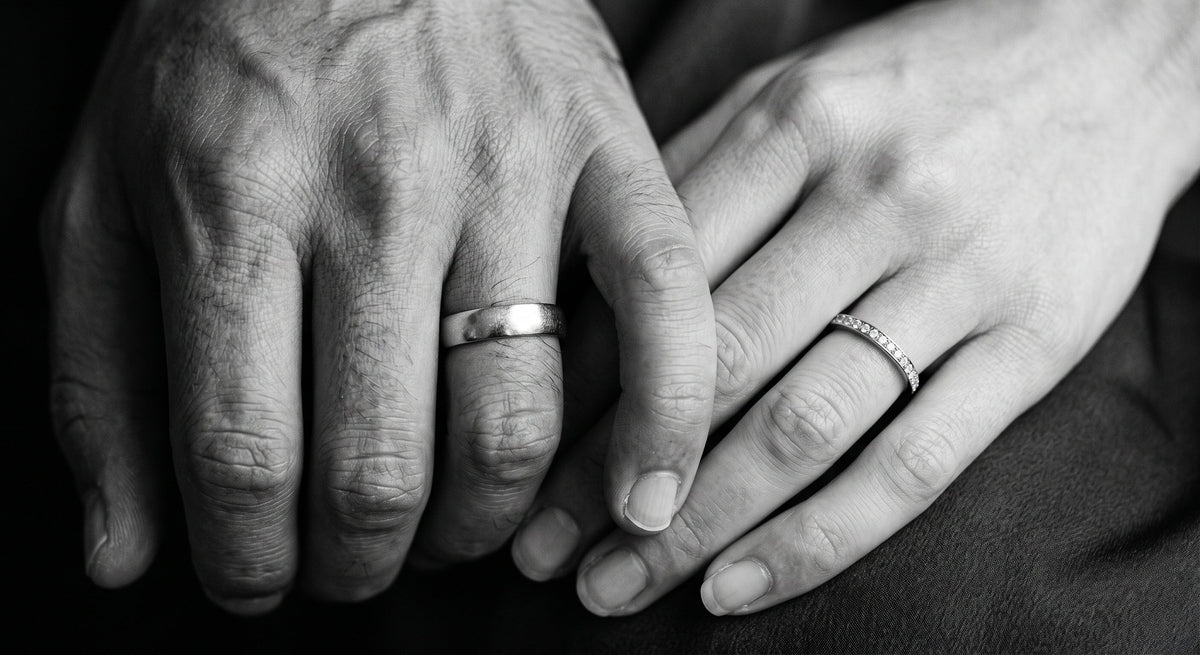
Two rings worn side by side constantly rub against each other. If they are of different hardnesses, the softer one wears down from contact with the other, sometimes visibly within a few years.
This is a point we systematically examine, and it guides the choice of metal for the wedding band based on that of the engagement ring. If your engagement project is still ahead of you, our article on custom engagement ring creation timelines details the process.
Width, profile, comfort
Three parameters that can only be judged on the finger, never from a drawing.
The width is chosen according to the hand. A wide band on a slender finger can hinder bending.
The profile refers to the shape of the cross-section: flat, half-round domed, comfort fit with a slightly rounded interior.
The weight, finally, is immediately felt.
Engraving
Most often on the inside: a date, names, a few words. It can be done by machine for perfect regularity, or by hand for a lively trace.
Plan for it from the design stage: an engraving added afterwards imposes constraints that could have been avoided by anticipating it.
Maintenance at five and ten years
A continuously worn wedding band slightly deforms, scratches, and thins out very slowly. Nothing alarming, but a check every five years allows the shape and surface condition to be restored before wear becomes structural.
For a set ring, this check mainly concerns the prongs or the setting rail, which wear out from contact with everyday objects. This is the only maintenance that should not be postponed: the loss of a stone is irreversible.
Come together
We offer private consultations, by appointment, on Mondays or Saturdays, outside of our opening hours.
Bring the engagement ring if you have one. Also see our custom creations.
Atelier Ulmann. Route de Thonon 52, 1222 Vésenaz. Make an appointment.