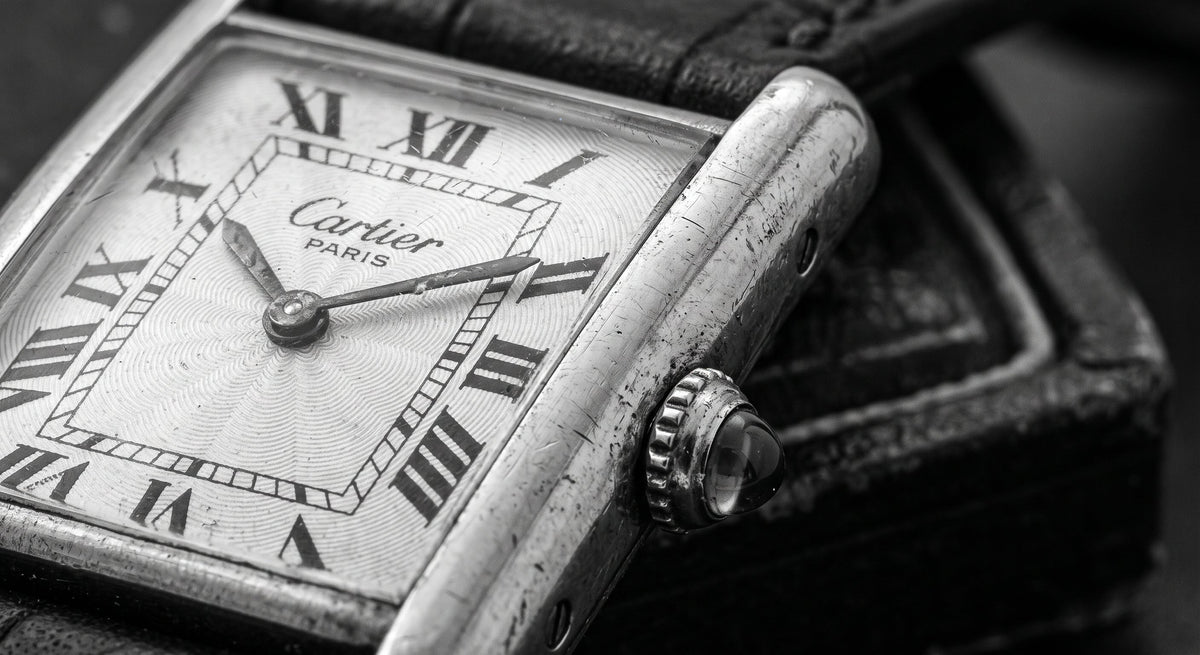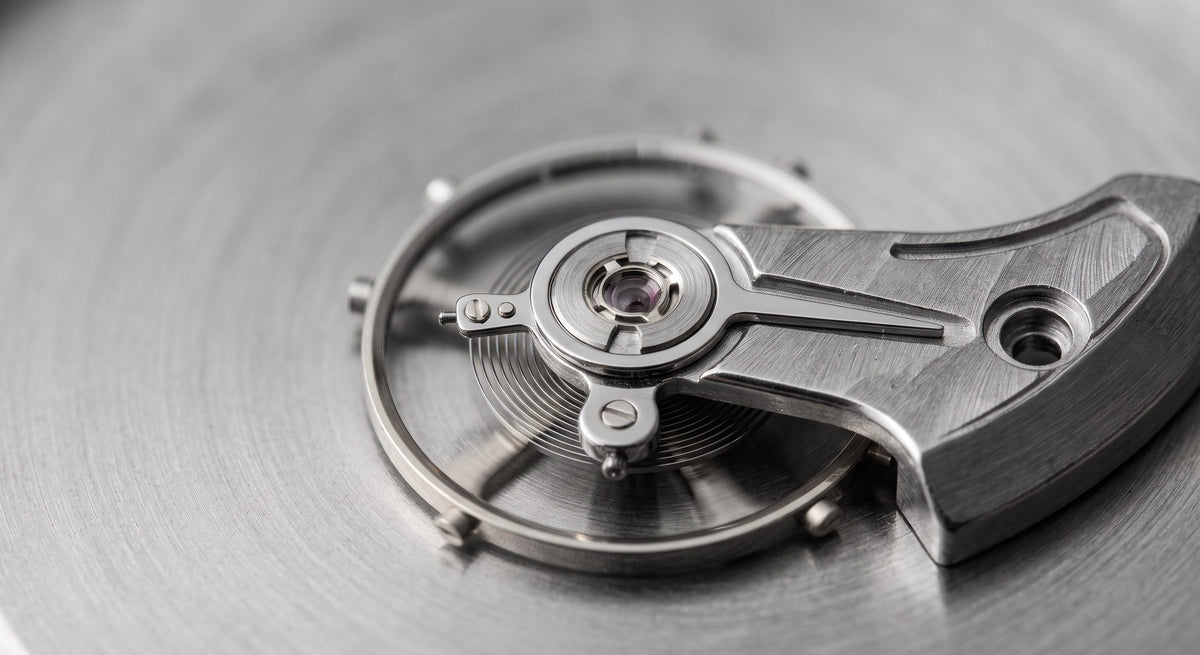
Servicing a mechanical watch: what it is for, how it is done
A mechanical watch operates without electronics, batteries, or stopping. Several hundred parts work against each other, at a rate of several thousand oscillations per hour, which amounts to several hundred million beats over a decade.
It's a miniature engine, and like any engine, it requires periodic maintenance, which is known as an overhaul.
What an Overhaul Really Is
The term is often confused with a simple cleaning, whereas it refers to the complete disassembly of the movement, piece by piece, down to the bare plate.
The reason for this is simple: oils. A mechanical movement relies on lubricants applied in tiny quantities at contact points, with each point receiving a specific oil or grease depending on the load and speed. These lubricants age. They thicken, migrate out of their intended location, and eventually dry up.
From that moment on, metal works against metal. This leads to wear, and it is irreversible: it cannot be repaired; it must be replaced.
Therefore, an overhaul consists of intervening before this stage. Not because the watch is malfunctioning, but precisely because it is still working.
How Often
The usual rule is every five to seven years for a regularly worn watch. This is an average, not a deadline, and several factors can shift it.
A watch worn daily requires more frequent maintenance than a piece taken out only occasionally. A watch left immobile in a drawer for ten years is not preserved for that reason: the oils degrade there too, sometimes even more so, due to lack of circulation.
Heat, humidity, and shocks accelerate the process. A case whose water resistance has not been checked for a long time is a risk factor in itself.
The most reliable signal remains its operation. A watch that gains or loses significantly more than before, whose power reserve decreases, or that stops without reason, requires examination without waiting for the theoretical deadline.
The Process in the Workshop
Diagnosis
First and foremost, the watch is observed in operation. Balance wheel amplitude, rate in several positions, power reserve, condition of the case and its water resistance. The movement is opened to identify worn or broken parts, traces of moisture, and previous interventions.
From this examination, a detailed estimate is provided, which is submitted to you before any work begins. Nothing starts without your agreement.
Disassembly
The movement is extracted from the case and completely disassembled. Each component is removed and classified. On a complicated movement, such as a chronograph, perpetual calendar, or repeater, the number of parts multiplies, and disassembly follows a strict order.
Cleaning
The parts are subjected to an ultrasonic bath, in successive solutions adapted to each material, then dried. The goal is to eliminate all traces of old oil and residues. A poorly cleaned movement that is newly lubricated results in a wasted overhaul.
Parts Replacement
Worn components are replaced: seals, and depending on the condition, mainspring, jewels, stems, pinions, or staffs. For old pieces whose components are no longer available, a part may be remanufactured.
We systematically return the replaced components. You should be able to see what came out of your watch.
Reassembly and Lubrication
The movement is rebuilt in reverse order, with each contact point receiving the specific oil or grease intended for it, in measured quantities. This is the most delicate step and the one that determines the longevity of the work.
Adjustment
The rate is adjusted then checked in several positions and over several days, as a watch does not behave the same way flat, on its side, or on the wrist. The movement is put back into its case, water resistance is checked, and the watch is observed in operation before return.
What Extends the Lead Time
An overhaul takes several weeks. Three elements extend it.
First, the complexity of the movement. A chronograph, perpetual calendar, or chiming watch represents a considerably greater amount of work than a three-hand movement.
Second, sourcing parts. Some parts are ordered, others are sought, and others are remanufactured.
Finally, the observation period, which cannot be compressed. A watch returned the day after its reassembly is a watch whose long-term behavior has not been verified.
All Watches, Without Exception
We work on manual and automatic movements, of all brands and eras, including complications and antique pieces.
The work is carried out in-house with the support of a small network of Genevan artisans with whom we have long-standing relationships. We are not an authorized service center for any brand and do not claim to be.
If you are also interested in case refinishing, it is a separate service that we detail in our article on polishing. And if the watch has value, an overhaul is a good time to update its valuation.
Dropping Off a Watch
Drop-offs and diagnoses are done from Tuesday to Friday, without appointment. We also receive clients on Mondays and Saturdays by appointment, for private consultation.
Bring any papers you have, as well as details of previous interventions if you know them. A watch that has been stopped for years should be dropped off as is: do not try to wind it to see if it starts again, as a dry movement suffers more from this than from its immobility.
Atelier Ulmann. Route de Thonon 52, 1222 Vésenaz. Make an appointment.