

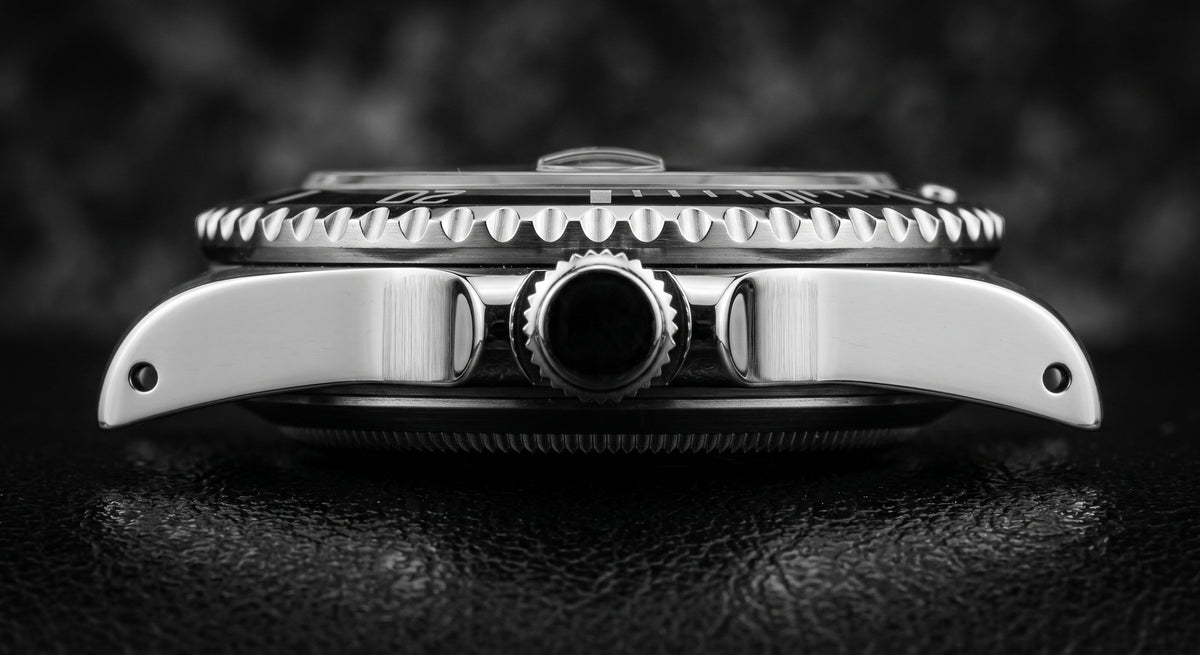
Watch case polishing and restoration
A watch worn for twenty years bears its twenty years. Usage scratches on the case band, impacts on the lugs, marked bezel, tarnished chamfers. Restoring it to its original condition is an operation we regularly perform, yielding spectacular results.
However, we must agree on what polishing means. It's not a single operation applied to a case. It's a succession of decisions, surface by surface, that determine whether the watch will emerge faithful to its design or simply shiny.
What we can do
Complete case refurbishment
Case band, lugs, bezel, case back, metal bracelet: all surfaces can be refurbished. Even on haute horlogerie pieces, even on cases whose geometry relies on sharp edges and narrow chamfers. The work is longer and requires more caution, but it is not out of reach.
A correctly refurbished case doesn't just shine. Its edges remain sharp, its satin finishes remain satin, and the contrast between finishes, which defines the character of a design, is restored as the manufacturer intended.
Laser recharging: rebuilding what has been lost
This technique removes most limitations. By adding material with a laser, we can rebuild a lug thinned by successive polishes, fill an ovalized spring bar hole, restore the thickness of a lost chamfer, or repair a deep impact.
The material is deposited in very thin layers, then reshaped and refinished according to the original finish. A watch that would have been considered too worn to be polished again regains its dimensions and can embark on a new life.
This is a demanding intervention, longer and more expensive than a standard polish. It transforms a tired case into a restored case, which is very different from a case that has simply been thinned further.
Polishing, satin finishing, brightening: three distinct operations
The vocabulary matters because it accurately describes what will happen on each surface.
Polishing creates a mirror surface. It applies to surfaces that the manufacturer intended to be shiny.
Satin finishing creates a matte, directional surface, achieved with a regular grain. It applies to the top of the lugs and many case bands.
Brightening only addresses the chamfers, those narrow bands between two planes, to restore their brilliance without affecting adjacent surfaces. It is also the final step of polishing, something very light that gives the watch a final gleam.
The difference between good and bad work almost entirely lies here. A case polished to a mirror finish on surfaces that were satin-finished will shine more but no longer resemble itself. For us, each surface is treated according to its original finish, noted before disassembly.
What we do not touch
Certain areas are deliberately excluded from the work, protected throughout the intervention. These are not technical limitations but choices that preserve the identity and value of the piece.
The case numbers, often engraved between the lugs, and the hallmarks. They are used for authentication, insurance, and resale. An illegible number complicates everything, permanently.